I Paid $245 to Grade Two Rookie Autos. Both Came Back PSA 8s.
The numbers up front: $244.97 grading cost. 2 rookie autos. Two PSA 8s. Net vs selling raw: ≈$0.
What I sent (July 2026)
Two low-numbered rookie autographs, one PSA order (arrived at PSA July 6, 2026), $244.97 total — $100/card grading at the Regular 15 tier plus shipping/insurance both ways:
| Card | Cert | Grade |
|---|---|---|
| 2025 Topps Signature Class Rookie Class Auto #RCA-CF — Cooper Flagg | 168530561 | PSA 8 / AUTO 10 |
| 2025 Topps NBA Hoops First Signs Black Light Burst #HFS-AB, 01/10 — Ace Bailey | 168530562 | PSA 8 / AUTO 10 |
Service level: Regular 15 ($100/card at the time, 15 business days published). Door-to-door turnaround: about 11 weeks (arrived July 6 → completed September 21, 2026) — the published 15 business days didn't survive contact with reality, and that's worth remembering the next time a tier's estimate feeds your EV math.
These weren't blind submissions like my first order. Low-numbered rookie autos with on-card-style signatures are exactly the cards where grading is supposed to pay: encapsulation plus an authenticated auto grade carries a real premium — my own rule of thumb from eBay solds is 30–70% over raw for PSA 8 / AUTO 10 duals at /25 and below. The Bailey was even pop 1.
What came back
Two 8s. Both with AUTO 10s — the signatures graded perfectly, the cards didn't.
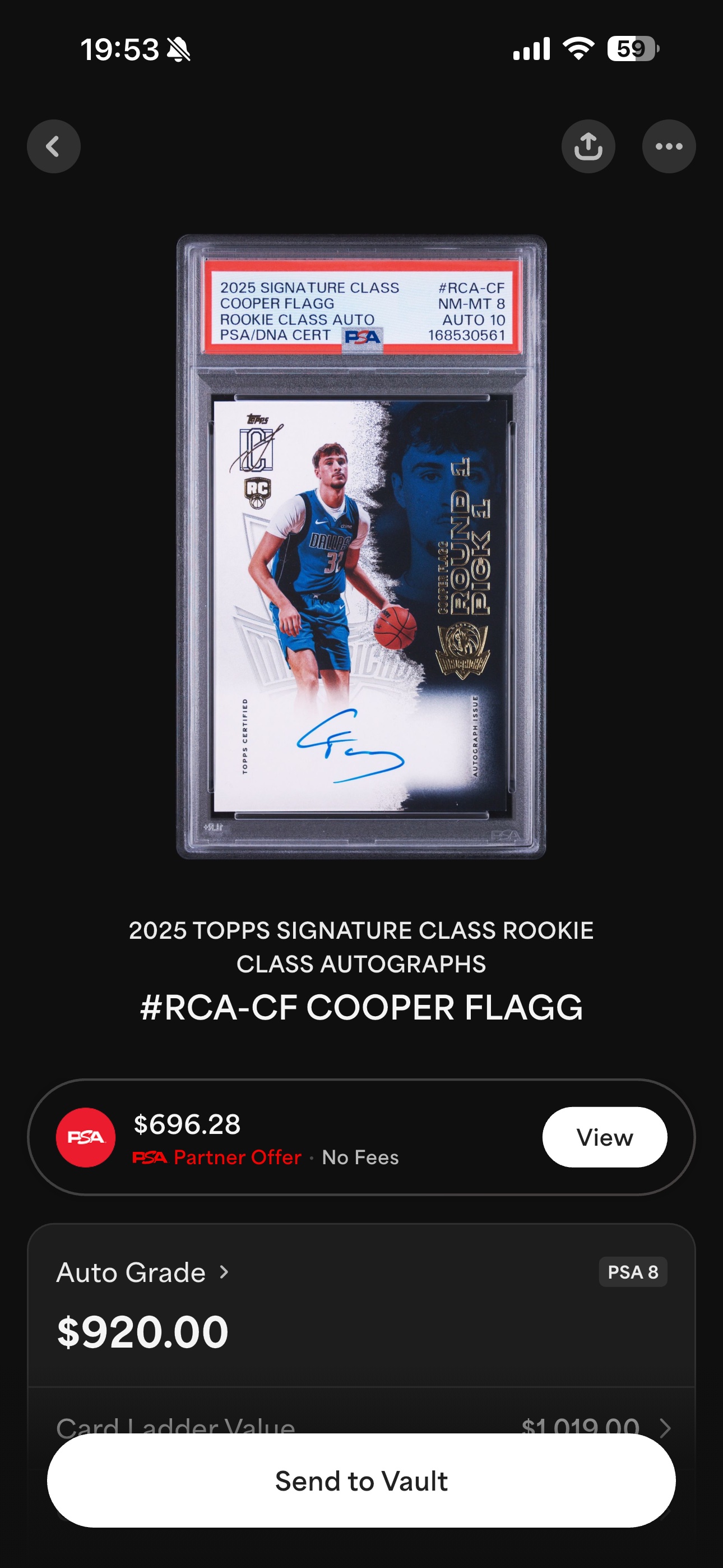
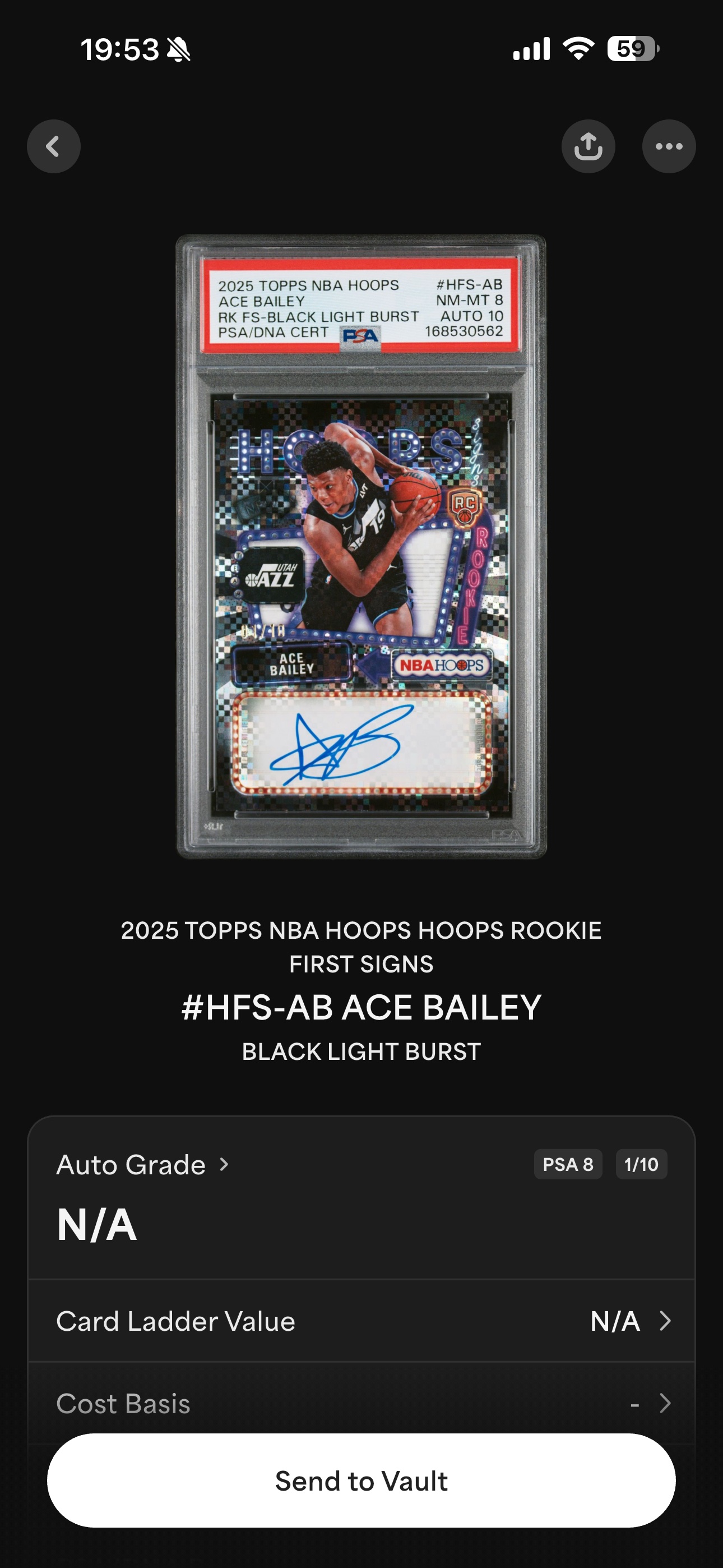
If you've submitted before, you know the specific sting: the auto grade is the one you can't control, and it came back perfect. The card grade is the one you thought you controlled, and it didn't gem. Twice.
The math
Here's the full recomputation, because the first version of this math was wrong and the correction is the whole story.
Flagg Signature Class auto (PSA 8/AUTO 10, pop 8):
- Raw: three recent solds — $879.69, $898, $880 → $885. Minus 13.5% eBay fees → ~$766 net
- Graded: only comp is a PSA 7/AUTO 10 at $999.99 (9/30); PSA estimate $912, CardLadder $978 → this PSA 8 estimated ~$975. Minus $122.49 grading share, minus 13.5% fees → ~$721 net
- Grading lost ~$45
Bailey First Signs Black Light Burst /10, 01/10 (PSA 8/AUTO 10, pop 1):
- Raw: zero sold comps. One live listing at $799.99 (OBO) → estimated $750, net ~$649
- Graded: no comps at all. Estimated ~$950 (range $850–1,050) using the low-numbered dual-grade premium rule → net ~$699
- Grading gained ~$50 — but the error bars are wide and the sample is paper-thin
Combined: $244.97 in grading bought ≈$0 versus selling raw — plus eleven weeks of waiting.
And here's the part that stings: when I first ran these numbers I used $15/card grading + $5 shipping, and the answer was "+$200, basically fine." Then the real receipt number came in — $244.97 for two cards, $122.49 each all-in — and the verdict flipped to zero. The cards didn't change. Only the cost assumption did.
Why two PSA 8s gave opposite answers
Same grades, opposite results. The difference is the starting line:
- The Flagg's raw was already expensive. At $885 raw, the card had to clear $122.49 in grading cost plus fees just to break even — and an 8 doesn't carry enough premium over a hot raw market to do it. The upside lived in the 9, which didn't happen.
- The Bailey's raw comp was thin, and the low-number premium carried it. A 01/10 with a perfect auto grade gets the encapsulation + authentication premium my comps show for low-numbered autos. Barely. On a thicker comp set this could easily read as $0 too.
- The 8 is the break-even line. On both cards, a 9 rewrites the story completely. That's now twice in a row the grade — not the card selection — decided the outcome (my first order went 0-for-6 on 10s). Gem rate is the tax I keep paying.
The lesson
Know your true all-in cost per card before you submit — not the grading fee, the everything. The "$15 grading fee" I had in my head was off by 8x once shipping, insurance, and the tier were included. That single wrong input flipped a +$200 decision into a $0 one.
And the check that matters for autos: price the PSA 8, not the PSA 10. If the 8 doesn't clear your all-in cost, you're betting everything on the 9/10 — so you'd better have a real reason to believe your copy gems. For low-numbered autos the 8 can clear it (Bailey did, barely). For refractors of non-superstar rookies, it usually can't (see: my first submission, six 9s, -$187.93).
That's the exact question the grading expected-value calculator answers: plug in the 8 price, the 9 price, the 10 price, and your true per-card cost, and it tells you whether the math works before PSA tells you the grade.
The core formula:
EV = Σ [ P(grade) × sale(grade) × (1 − eBay fee) ] − grading cost − raw cost
Run it with honest grade probabilities. If your realistic chance of the 9/10 is below the break-even line, the submission is a donation to PSA.
Frequently asked questions
How much did it really cost to grade each card?
$122.49 per card all-in ($244.97 total for two cards: $100/card grading at the Regular 15 tier plus shipping and insurance both ways). The "$15 grading fee" figure I had in my head was off by 8x — and it flipped the verdict from +$200 to $0.
Why did the same grades produce opposite results?
The starting raw prices differed. The Flagg's raw market was already $885, so the PSA 8 premium couldn't cover $122.49/card in costs. The Bailey's raw comp was thin ($750 estimated) and the 01/10 serial plus perfect auto grade carried just enough low-number premium to edge positive — with wide error bars.
Is PSA 8 the break-even line for grading rookie autos?
On these two cards, effectively yes. A PSA 9 on either one rewrites the P&L completely. The premium curve between 8 and 9/10 is steep — that's where nearly all the grading profit lives.
Should you grade low-numbered rookie autos?
Only if the PSA 8 price clears your true all-in cost. Check the 8's comps first, not the 10's. Thin comps (like the Bailey's, with zero graded sales) mean your answer has wide error bars — size the bet accordingly.
Are these P&L numbers final?
No — they're valuation-based (paper), not realized sales. Both slabs are still held. I'll update this post when they sell.
References
- PSA grading standards — what separates an 8 from a 9
- 130point — look up actual Best Offer sale prices
- eBay sold listings — verify the PSA 8 vs. raw spread yourself
Published figures: grading cost $244.97 per confirmed receipt total ($100/card Regular 15 grading + shipping/insurance; order number and date on file, redacted). Raw comps from eBay sold listings checked 2026-10-10; graded valuations estimated from nearest comps + PSA/CardLadder estimates with thin-sample caveats stated. Fee assumption: 13.5% eBay all-in. Cert numbers verified against slab images (public slab data, kept). Order number, payment details, and personal name redacted. Status: ongoing — both slabs held; paper P&L ≈$0 vs selling raw. Published 2026-10-16.