From Redemption to PSA 10: My Cooper Flagg Chrome Auto — Was the $234 Grade Worth It?
The numbers up front: Redemption pulled by hand → redeemed → graded PSA 10 / AUTO 10. Grading cost $233.99 on Express — and still took 62 days. Raw value ~$1,200. The graded card needs to sell for ~$1,471 just to beat selling raw.
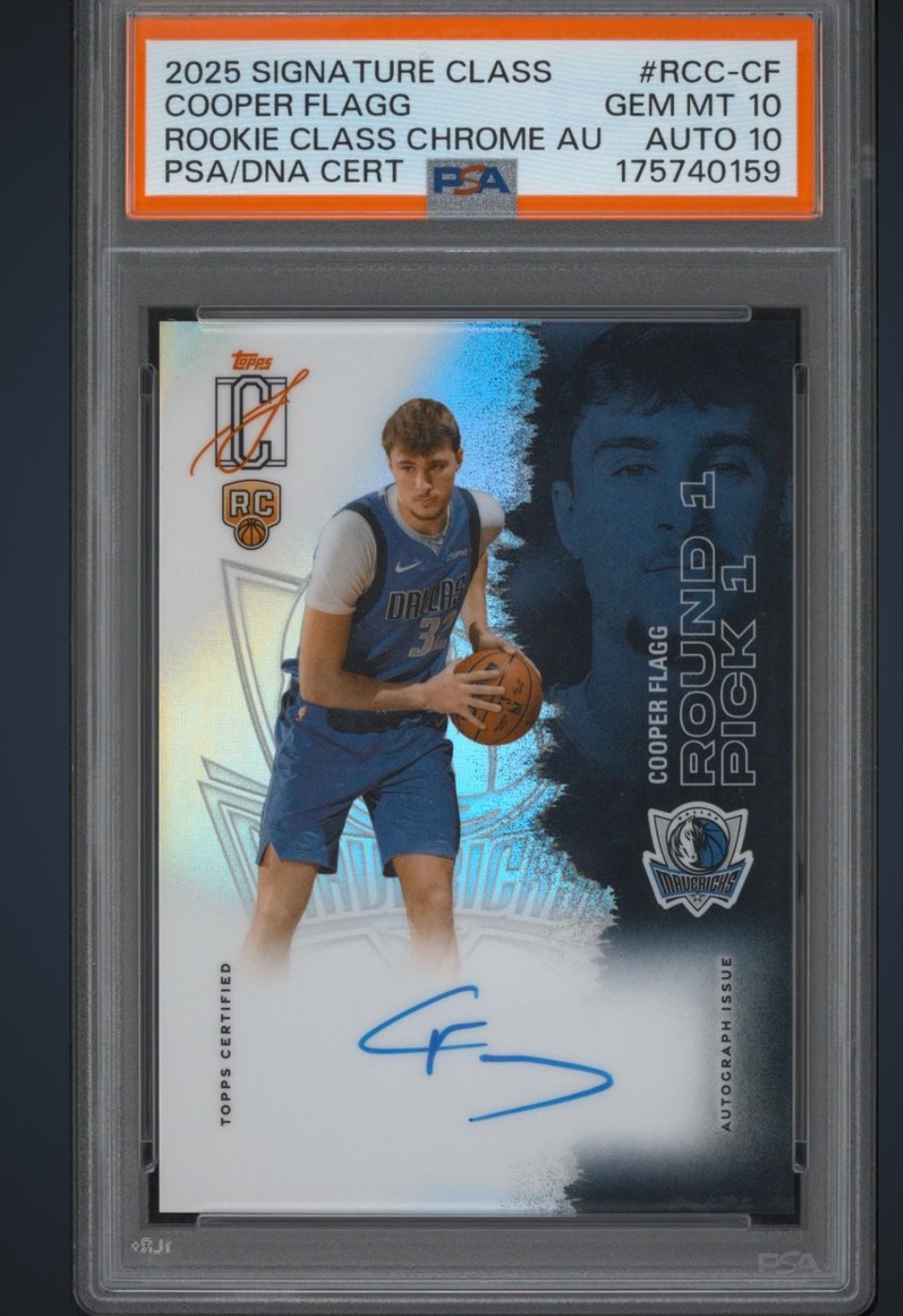
The card
2025 Topps Signature Class, Rookie Class Chrome Autographs, #RCC-CF, Cooper Flagg (Dallas Mavericks). The base chrome auto — unnumbered, Topps-certified autograph, from the 46-card Rookie Class Chrome Autographs set. Don't confuse it with the paper version: the RCA-CF is the base Rookie Class Auto on paper stock. I graded one of those earlier and it came back PSA 8 / AUTO 10 (see the Flagg + Bailey case). This chrome one is a different card — and it gemmed.
The slab label reads: 2025 Signature Class, Cooper Flagg, Rookie Class Chrome AU, GEM MT 10, AUTO 10, PSA/DNA cert 175740159.
How it got here: redemption, then grading
A redemption is a two-wait journey. First you pull a placeholder card with a code, not the real card. You redeem it with Topps and wait for the player-signed card to be fulfilled and shipped. Only then do you hold a physical card you can inspect — and submit.
That matters for the grading decision: with a redemption, you can't pre-grade the card before you own it, and you can't choose which copy you get. The copy Topps sends is the copy you grade. This one arrived in gem condition. That is luck as much as judgment, and it should be priced into any redemption grading decision.
The PSA timeline, from the submission tracker:
| Stage | Completed |
|---|---|
| Arrived at PSA | August 26, 2026 |
| Order Verification | August 26, 2026 |
| Research & Identification | September 3, 2026 |
| Authentication & Grading | October 22, 2026 |
| Encapsulation | October 27, 2026 |
| Holder & Label Review | October 27, 2026 |
| Grades ready | October 27, 2026 |
Door-to-door: 62 days on an Express submission. The long stage was Authentication & Grading itself — September 3 to October 22. PSA was working through a multi-million-card backlog in this period and had confirmed that existing orders are graded before new submissions. Lesson, stated plainly: during a backlog, the tier name on the invoice is not a delivery promise. If your sale depends on a date, grade early or don't grade.
What it cost vs what it's worth
- Grading bill: $233.99 all-in — one card, Express tier, including shipping and insurance. That's 19.5% of the card's raw value before any selling fees.
- Raw value: ~$1,200 (my estimate). Supporting evidence, labeled honestly: a same-card auction was live on eBay at $1,166.14 with 0 bids at last check — an asking price, not a sale. No same-card PSA 10 sale had been recorded as of October 27, 2026.
The breakeven, at ~13.5% selling fees:
| Path | Gross sale | After ~13.5% fees | After grading |
|---|---|---|---|
| Sell raw | ~$1,200 | ~$1,038 | — |
| Sell PSA 10 (breakeven) | ~$1,471 | ~$1,272 | ~$1,038 |
In plain terms: the PSA 10 has to sell for about $271 more than raw just to cover the grading bill and the extra fees on the higher sale price. A dual 10 (card gem + auto gem) is the best possible outcome for an autograph card — the AUTO 10 protects the signature premium that a PSA 10 with a lesser auto grade would lose. But "best possible outcome" is not a sale. Until a same-card PSA 10 actually sells, this case has no profit verdict — only a breakeven line. That's the honest place to stop.
How rare is this card?
The Rookie Class Chrome Autographs set has 46 cards. Published pack odds for pulling any card from the set:
| Parallel | Hobby | Hobby Jumbo | Value | Mega |
|---|---|---|---|---|
| Base (unnumbered) | 1:25 | 1:10 | 1:631 | 1:406 |
| Orange /50 | 1:367 | 1:182 | 1:11,307 | 1:6,453 |
| Red Lava /25 | 1:717 | 1:356 | 1:21,906 | 1:12,577 |
| Red /25 | 1:734 | 1:365 | 1:23,367 | 1:12,906 |
| Gold /10 | 1:1,833 | 1:902 | 1:58,416 | 1:32,013 |
| Blue /5 | 1:3,666 | 1:1,803 | 1:140,199 | 1:63,206 |
| SuperFractor 1/1 | 1:17,848 | 1:9,015 | 1:1,080,000 | 1:308,125 |
Odds data via D-W Cards (2025-26 Topps Signature Class Basketball odds table); serial limits per the published product checklist. Simple derived math: at 1:25 hobby packs for any card in the 46-card set, a specific player's base auto — Flagg, in this case — works out to roughly 1 in 1,150 hobby packs, assuming all 46 autos are equally weighted (Topps doesn't guarantee that). The redemption layer sits on top of that: this card wasn't pack-pulled as a physical card at all.
The grading decision, in hindsight
- Redemptions are graded blind at pull time. You commit to the player before you see the card. The only control you have is inspecting the fulfilled card before submitting — and deciding then whether it is worth the fee.
- Fee load matters more than the grade. $233.99 on a ~$1,200 card is a 19.5% load. A gem result doesn't automatically clear it; only a sale $271 above raw does.
- Express is a price, not a promise, during a backlog. 62 days on Express. If timing mattered, this submission would have missed it.
- Dual 10 is the ceiling, not the floor. PSA 10 / AUTO 10 is the best outcome this card can carry. If the market won't pay $1,471 for it, no better grade exists to rescue the decision.
Running your own redemption-or-raw numbers? Try the grading expected-value calculator.
Frequently asked questions
What is a redemption card, and why did this Cooper Flagg card take months to reach PSA?
A redemption card is a placeholder pulled from a pack: instead of the physical card, you get a code to claim it from Topps once the player has signed. This Flagg redemption was pulled, redeemed with Topps, and the physical card was then submitted to PSA — so the journey had two waits (Topps fulfillment, then PSA grading) before the grade existed.
Is the RCC-CF the same card as the RCA-CF Cooper Flagg auto?
No. Both are 2025 Topps Signature Class rookie autos of Cooper Flagg, but RCA-CF is the paper base Rookie Class Auto and RCC-CF is the chrome version (Rookie Class Chrome Auto). They are different cards with different markets. The RCA-CF from an earlier submission graded PSA 8 / AUTO 10; this RCC-CF graded PSA 10 / AUTO 10.
How much did it cost to grade this card?
$233.99 all-in for one card at PSA's Express tier, including shipping and insurance — about 19.5% of the card's ~$1,200 raw value.
Why did an Express submission take 62 days?
The card arrived at PSA on August 26, 2026 and grades were ready October 27, 2026. PSA was working through a multi-million-card backlog in that period and confirmed existing orders were graded before new submissions. The long stage was Authentication & Grading itself (September 3 to October 22). Express pricing did not buy an express turnaround during the backlog.
Should I grade a ~$1,200 redemption auto, or sell it raw?
Do the breakeven first. At ~$1,200 raw and ~13.5% selling fees, selling raw nets about $1,038. After the $233.99 grading bill, the PSA 10 needs to sell for about $1,471 just to break even versus selling raw — roughly $271 more than raw. No same-card PSA 10 sale had been recorded as of October 27, 2026, so that call is a judgment call, not a comp-backed verdict.
References
- D-W Cards — 2025-26 Topps Signature Class Basketball odds table (pack odds; site is a single-page app — open Topps Odds → Basketball → Topps Signature Class Basketball → Odds tab)
- 2025-26 Topps Signature Class Basketball Checklist — Checklist Insider (set composition, parallel serial limits)
Published figures: grading cost $233.99 per confirmed receipt total (Express tier, 1 card, shipping/insurance included; order and receipt numbers, payment details, and personal name redacted). Timeline from the PSA submission tracker (arrived Aug 26 → grades ready Oct 27, 2026). Raw value ~$1,200 is the owner's estimate; the live same-card eBay auction at $1,166.14 (0 bids) is an asking price, not a sale. No same-card PSA 10 sold comp found as of Oct 27, 2026 — breakeven math shown instead of a graded-value estimate. Fee assumption: 13.5% eBay all-in. Cert number verified against the slab image (public slab data, kept). Status: graded, no sale yet. Published 2026-10-27.